


Por Isabel Hernandez Pepe

Monika de Silva
Why Care Matters for EU–Latin America Cooperation?
In times of widespread impunity for states accused of committing genocide, in times of profound disregard for human lives across multiple armed conflicts characterized by escalating violence and death, and in times of unprecedented—and increasingly expected—heatwaves that are dangerously overheating our environment across Europe and beyond, transnational solidarity and global cooperation centered on care should be at the top of the international agenda. Building more caring societies requires cooperation that transcends national boundaries and recognizes our deep interdependence in confronting global crises. A promising starting point lies in strengthening collaboration between Latin America and the European Union. Latin America has emerged as a particularly important laboratory for care-related policies and debates, making significant contributions to global discussions on care as a public, collective, and rights-based responsibility. While several European countries have long-established care infrastructures and often perform better on indicators such as access to affordable childcare, healthcare provision, and gender equality in care arrangements, Latin America has been distinctive in advancing a more holistic vision of care that extends beyond its economic dimensions. As we argued in our recent policy study, the region has increasingly framed care as a pillar of social justice, gender equality, and democratic transformation, linking it to broader questions of rights, interdependence, and social reproduction. By contrast, the European Union’s engagement with care as an explicit political project has gained momentum more recently and has tended to emphasise its socioeconomic and labour-market implications . Nevertheless, recent developments, such as the European Care Strategy (2022), signal a growing recognition of care as a matter of public policy and collective responsibility. In this short blog, we will first summarize the achievements in building care societies across both the LAC and the EU regions. Secondly, we will critically assess the new EU-LAC Bi-regional Pact on Care, signed in November 2025, and, finally, we will provide guidance on how future cooperation between the two regions should broadly look.
How Latin America Became a Global Leader in Care Policies
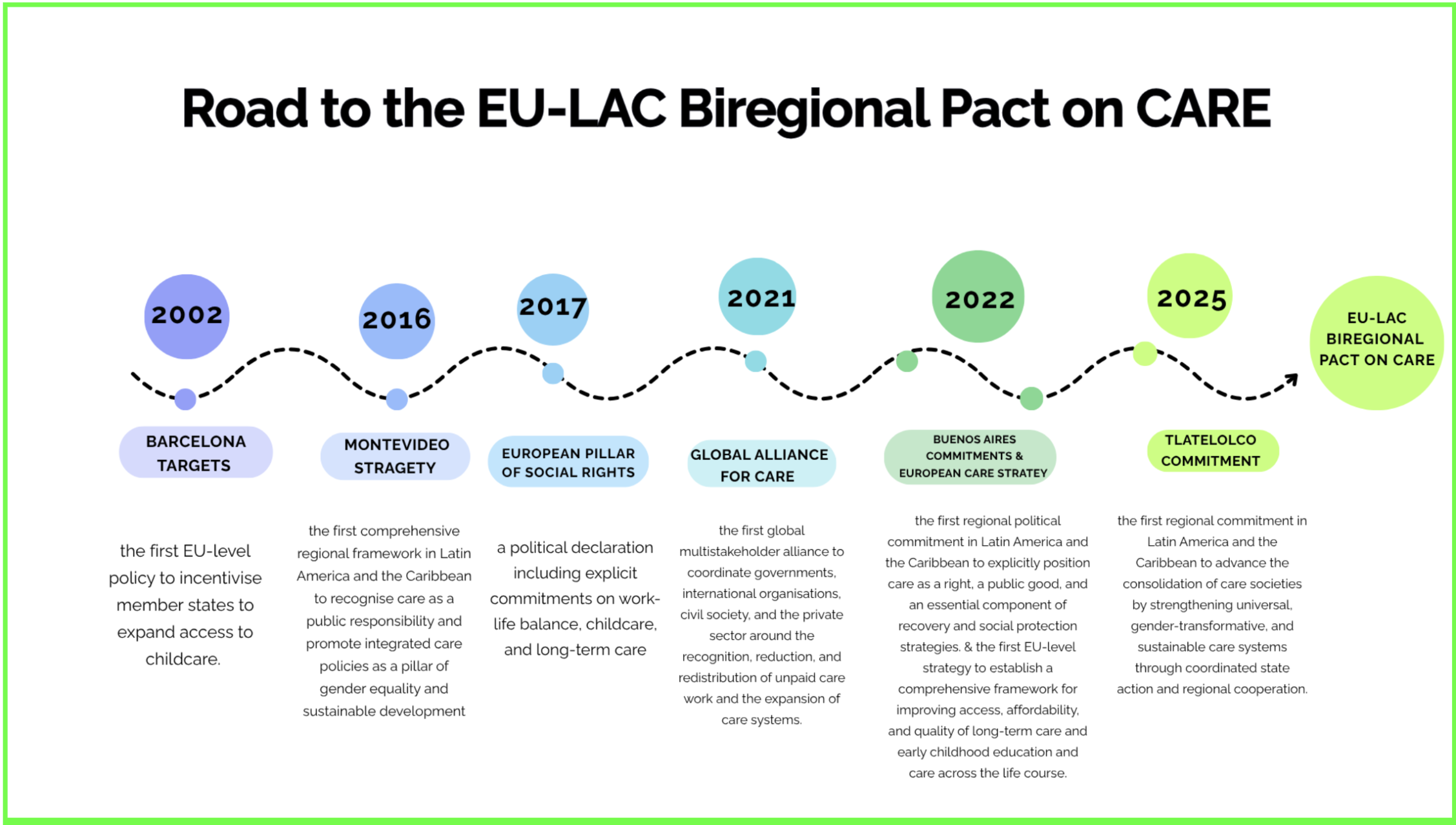
Already in the ’70s Latin American and Caribbean states were discussing care-related topics such as caregiving services for children, the need to frame care as a right, or themes of the redistribution of care between states, markets, and society. In this blog post we will focus on the most recent milestones of the LAC regional commitment to care which include the groundbreaking Montevideo Strategy (2017), the creation of the Global Alliance for Care (2021), the Buenos Aires Commitments (2022), and finally the Tlatelolco Commitment (2025).
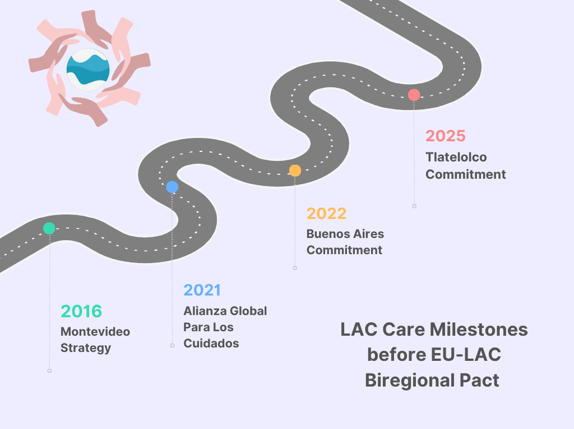
In the Montevideo Strategy, adopted in 2016 by the ECLAC (Economic Commission for Latin America and the Caribbean), concepts such as patriarchy, the predominance of a culture of privilege, and the concentration of power and hierarchical relations in the public sphere are central to the strategy’s call for action. We can already see a strong, critical, and radical assessment of what is needed to achieve equality in 2030, as one of the objectives of the UN Regional Agenda. In a sense, rather than using more technocratic language, the strategy recognizes and acknowledges the structural barriers and limitations of our own society that hinder the promotion of and shift toward a society based on care, to indeed move toward a fairer ‘care society’. In 2021, the Alianza Global para los Cuidados (in English, Global Alliance for Care) was co-convened by the Mexican National Institute for Women (INMUJERES) and ONU Mexico in the framework of the Generation Equality Forum, as ‘the first global multi-stakeholder community that facilitates and fosters spaces for dialogue, analysis, exchange of experiences and learning about care’. In the member section of the alliance website, we can count on many international organizations, civil society, official governments, and private-sector representatives joining efforts to advance a transformative vision of care, based on the 5Rs of care: recognize, reduce, redistribute, reward, and represent. While this network has definitely made many powerful points in international and national fora and mobilized resources for the objectives mentioned above, questions about how far they can push remain up for debate.
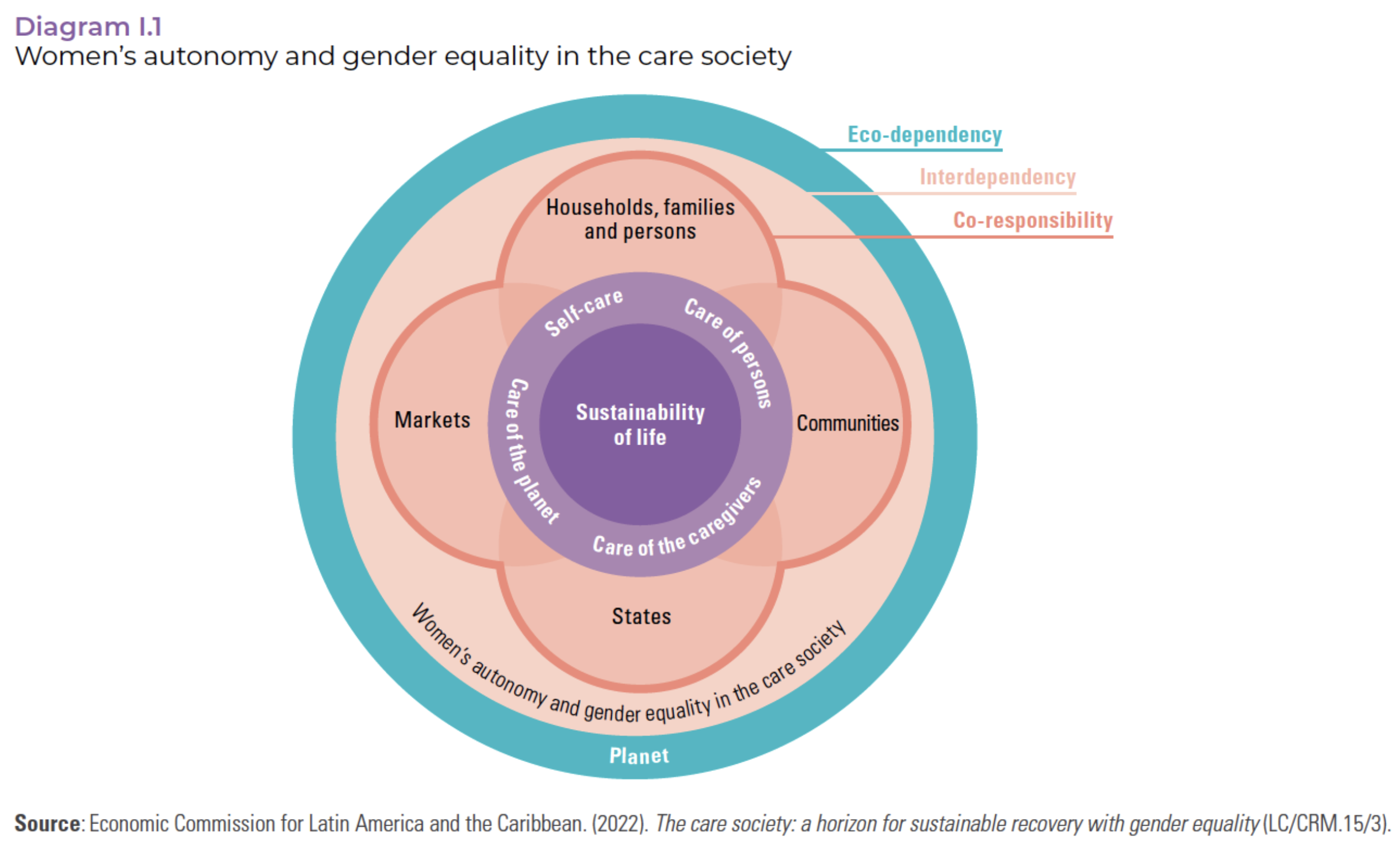
Coming back to the more ‘official declarations’ of the LAC countries, in the Buenos Aires Commitment, adopted in 2022 by again the 35 members of the ECLAC, the notion of care society is much more detailed and specific: “a care society translates, among other things, into a better quality of life for all persons, a reduction in social, economic, and gender inequalities, promotes active aging, creates new jobs, and cares for the planet”. From this definition, it is clear that care is not just for women and girls, but for all lives, including the life of the planet that hosts us. The new paradigm of interdependence (eco-dependency; interdependency and co-responsibility, as shown in the graph below) becomes evident, arguing that care is not just a sector of the economy or yet another buzzword to be used and instrumentalized when needed, but rather the foundation of our society. Long story short: without care, none of us would be either writing or reading this piece.
Lastly, in the Tlatelolco commitment, adopted in 2025, the document’s language becomes even bolder, reflecting a strong and brave commitment to building a caring society amid a global moment of uncertainty. The global chain of supply of migrant workers is mentioned as a way to argue that social security systems should be redesigned to take into account the huge amount of unpaid work carried out primarily by (often undocumented and ‘illegal’) migrant women. Foreign policy is also explicitly mentioned for the first time. It represents transformative feminist foreign policies as an avenue to bring transformation to governments and institutions that, despite many declarations, have not been able to bring feminist peace, climate justice, and sustainable development in our battered and tormented world, at the mercy of a bunch of crazy, egotistical, warmongering, racist old men, like Donal Trump, Elon Musk, Vladimir Putin, Benjamin Netanyahu, among many others. Talking about men, in this last commitment the necessity of engaging men and boys is explicitly stated, to move beyond the mistaken assimilation of care as a women’s topic and to make them equally responsible for advancing the equal distribution of domestic and care work.
Beyond the strong regional declarations promoted through ECLAC, Latin America has emerged as a global laboratory for reimagining care as a matter of rights, social organisation, and state responsibility. While individual initiatives such as parenting programmes, policies promoting active fatherhood, and the extension of social protection to domestic workers can also be found in other world regions, Latin America’s distinctiveness lies in its broader normative and institutional approach to care. Several constitutions have incorporated care-related provisions, including the explicit recognition of the right to care in Mexico City’s Constitution (2017), the recognition of unpaid care and household work as productive labour in Ecuador, Venezuela, and the Dominican Republic, and constitutional commitments to care for older persons. Moreover, several countries have established comprehensive national care systems that seek not only to expand care services but also to recognise, reduce, and redistribute unpaid care work and transform the gendered social organisation of care. Together with the region’s holistic understanding of care, which encompasses the rights to receive care, provide care, and practise self-care, these developments position Latin America at the forefront of contemporary debates on care as a human right and a pillar of social reproduction.
Despite these important advances, significant challenges remain. The ambitious regional commitment to building a care society continues to coexist with widespread labour informality, particularly among domestic and care workers, limiting access to labour rights and social protection. Moreover, discussions of care have often paid less attention to collective bargaining and caregivers’ working conditions. At the same time, persistent levels of gender-based violence across the region continue to constrain women’s autonomy and reinforce unequal care responsibilities as women spend roughly triple the time on unpaid care work compared to men .Building on the Latin American experience, we now turn to the European Union’s emerging care agenda.
The Evolution of Care Policies in the European Union
In Europe, care-related policies have been on the agenda of left-wing political forces since at least the industrial revolution. In Western Europe, many different welfare models emerged, each striking a different balance between capitalist economic systems and state intervention. A few broad types are well established in the literature: the social democratic model (Sweden, Denmark, Norway), the corporatist model (Germany, France, Italy), and the liberal model (United Kingdom, Ireland). In Central and Eastern Europe, communist regimes developed their own structures for providing state services like healthcare and childcare. To this day, these legacies shape significant differences in how European countries approach care. Alongside these divergences, however, several common trends have emerged: the neoliberalisation of care, growing concern about the consequences of care displacement such as falling birth rates, and the increasing transnationalisation of both care work and care policy.
For a long time, social policy and care remained at the margins of European integration, as nation states were considered better placed than EU institutions to govern these areas. Gradually, however, it became clear that a common market cannot function on economic policies alone, and the EU became more involved in gender equality and welfare. The first EU-level legislative intervention in care came in 1996, with a Directive on parental leave establishing minimum requirements across member states. In 2002, the European Council set the Barcelona targets — the first EU-level policy to incentivise member states to expand access to childcare. Throughout the 2000s and 2010s, care was addressed at EU level primarily through so-called soft governance: a coordination mechanism requiring member states to report on social protection, pensions, and health and long-term care, without binding legal obligations. A significant turning point came with the European Pillar of Social Rights (2017), a political declaration including explicit commitments on work-life balance, childcare, and long-term care. Its momentum was then accelerated by the COVID-19 pandemic, which made the failings of European care systems impossible to ignore. In 2022, the EU adopted its most ambitious initiative to date: the European Care Strategy. Its concrete outcomes include the Work-Life Balance Directive, which introduced, among other measures, a non-transferable two-month parental leave entitlement for each parent; EU funding to support member states’ long-term care reforms; and communication campaigns to combat gender stereotypes around care.
In recent years, as the EU’s agenda has been geared more towards growth and competitiveness, interest in care and social policy at the European level has noticeably receded. What remains, however, is the conviction among progressive European actors that care policy deserves serious attention at the pan-European rather than purely national level. It is by now acknowledged by the EU that care generates economic value, is indispensable to society, requires public support and cannot be left to private markets alone, and that a more equal distribution of care responsibilities between women and men is both desirable and necessary. Yet, as we argue in a recent policy study (de Silva & Hernández Pepe, 2026), the EU’s approach remains too focused on the instrumental value of care as a necessary precondition for enabling “the economy,” particularly female labour market participation, rather than as a societal value in its own right.
The Origins and the Content of EU-LAC Biregional Pact on Care
On the 9th of November 2025, in the framework of the CELAC-EU Summit in Santa Marta, the EU-LAC Bi-regional Pact on Care was signed, and a Joint Declaration was published. It included the signatures of the 27 EU member states and 17 LAC countries. The pact is an informal, values-based framework for cooperation in which both regions are committed to strengthening their “shared vision” on care policies, care systems and care programmes. A more detailed explanation of the differences among these three concepts is not provided in the joint declaration: additionally, in point. 12 ‘care economy’ is also included in the document by stating that the bi-regional pact is also aiming to ‘enhance public-private partnerships with multi-stakeholder approaches through innovative investments in the care economy’. Nevertheless, the declaration uses quite strong discourse, recognizing care as a need, a responsibility, a co-responsibility and an essential element for social justice and human dignity (point 5), acknowledging the intersectional and cross-cutting dimensions of care (point 6), and the urgency of redistributing care responsibilities (point 7).
But how did this bi-regional pact on care come about? It did not come out of nowhere, and it is in fact the result of a cooperation and dialogue process which started some years ago, strongly facilitated by the EU-LAC Foundation, an international organization based in Brussels created precisely to strengthen the EU-CELAC partnership and to promote mutual knowledge and understanding between the two regions. In fact, the first time representatives from LAC and the EU advocated for an agreement on care policies between the two regions was at the EU-LAC Gender Equality Forum, organized by the EU-LAC Foundation, in Berlin. Some months later, at the EU-CELAC Summit of Heads of State and Governments, held in July 2023 after 8 years without a meeting, a joint declaration on advancing progressive policies was signed, but unfortunately care was mentioned only once, mostly sidelined.
Finally, a few days later, in Madrid, at the Euro-Latin American Parliamentary Assembly, also known as EuroLat, many parliamentarians from both regions conveyed their willingness to draft and sign a bi-regional pact on care finally. Yet, it would have taken two more long years to eventually arrive at the document that we are now summarizing and, later, assessing. It could be argued that, once again, the efforts of the Latin American countries that signed the Tlatelolco commitment offered an opportunity to reopen the conversation and take this first step. Still, there may also have been a variety of other reasons we may never know. What we can definitely do, is to acknowledge the big steps taken by institutions and governments while also assessing what is missing, what has been excluded, what could be better, and what could be improved. This is exactly what we are going to do in the next and final section before concluding with some advice on how to deal and behave, particularly in the hostile, violent, and repressive moments we are all living through.
Assessing the EU–LAC Bi-regional Pact on Care: Ambitions and Limits
As critical scholars and researchers, we must ask ourselves questions such as: are these commitments enforceable or only aspirational? Who is centered in the discourse promoted in the declaration? What seems to be missing in the analysis of care systems? Are concepts like intersectionality, demilitarization or socio-economic justice directly or indirectly included? These are only a few of the questions that can arise when reading international and intergovernmental declarations on care, but let’s start with those. To conduct the assessment, the proposals published by the Grupo de Trabajo de la Sociedad Civil CELAC-EU (2025) were also taken into account to cross-check and analyze which ones made it to the final draft and which proposals were instead put aside.
First, regarding the concepts, we see that the global care chains are not mentioned in the joint declaration, thereby erasing the peculiar difficulties experienced by (women) migrants, who notoriously live in more precarious conditions and are made socially invisible. Environmental concerns are also largely sidelined, even though protecting the environment is foundational to building care systems, especially given that majority-world countries are the most affected by environmental disasters. We can find a note on environmental protection just towards the end when the declaration states: ‘A care society that also embraces self-care, mutual care, and environmental protection, grounded on a comprehensive approach that seeks to ensure the sustainability of life and the planet’ (point 8). Moreover, the involvement of men and boys, central for the redistribution of care responsibilities, is not explicitly mentioned as the main goal of the bi-regional cooperation. Secondly, while acknowledging the importance of the EU-LAC Foundation in efforts to bring the two regions together, we need to highlight that the Brussels-based organization appears to be the only one responsible for this pact on care and for its implementation. Consultations with representatives and civil society are mentioned at the end; nevertheless, this gives the impression of a highly monopolized leadership, which poses many risks, such as a low level of engagement with diverse realities, difficulties in the practice of power-sharing and checks on accountability, among many others. It would be more auspicious to have a more diverse and horizontal stewardship in terms of who manages the implementation and the efforts to strengthen cooperation. Additionally, details about the financial terms of how this cooperation would work are completely missing, leaving the impression that, for now, the commitments signed by the two regions are mainly aspirational rather than actually enforceable. Last but not least, the declaration does not (yet) offer any solutions nor name problems present in each region—such as shortages of affordable childcare or low uptake of paternity leave by men. It remains to be seen what the cooperation can bring. We would recommend using the potential of the EU-LAC cooperation for cross-regional inspiration, for example, the adoption of non-transferable leave schemes in Latin America, alongside a more society-centred understanding of care in Europe.
At the same time, the Pact’s declaration is not without promise: by shifting away from the economy-driven discourse of care often dominant in EU documents, it opens up a more holistic understanding of care that may yet provide a more transformative foundation for future cooperation.
The Future of EU–Latin America Cooperation on Care
While transnational anti-gender and anti-feminist mobilizations are undeniably gaining strength across different regions of the world, it is important not to lose sight of the significant progress that has been achieved. As Nadine Gasman Zylbermann, former President of Mexico’s National Institute for Women (INMUJERES), has argued, “ten years ago it would have been impossible to talk about care in multilateral spaces”. The very fact that care has become a topic of discussion—and increasingly of policy commitment—in international and bi-regional forums should not be underestimated.
This recognition invites us to move beyond a purely defensive posture. While resisting anti-gender backlashes remains essential, it is equally important to invest energy in advancing transformative agendas. Rather than focusing exclusively on blocking attacks against feminist achievements, we must cultivate the willingness, proactivity, and forward-looking vision necessary to expand them. To borrow a sporting metaphor, it is not enough to defend our goal; we must continue creating opportunities and scoring new ones.
Both Europe and Latin America are hubs of innovation in care policies but at the same time are not free from shortcomings and therefore can build on each other’s strengths. Together, they constitute a third of the UN membership and a quarter of the world economy – a power to reckon with. From this perspective, the EU–LAC Bi-regional Care Pact represents a significant milestone—not only for relations between Europe and Latin America, but also for the broader project of building global cooperation around care. As we can read in one of the press releases published by EEAS, “ These two regions can lead the way in creating a fairer, more caring world—one that values the contributions of care workers” . The Bi-regional Care Pact should therefore be seen not as a final achievement, but as the first of many goals in a much larger effort to place care at the center of international cooperation, social justice, and sustainable futures. In the future, we would like to see the EU-LAC cooperation translating to global leadership on care of these two regions which should be continuously monitored and assessed by progressive feminist civil society actors.